Beyond eSource – Redesigning research around everyday healthcare
Why the future of clinical research lies in embedding research into routine healthcare
Clinical trials and routine healthcare are now both highly digital, but they still operate as separate data environments. As a result, information already captured during everyday care, including diagnoses, prescriptions, laboratory results and clinical events, is often recreated in trial systems, adding avoidable work for sites, participants and data-management teams.
For sponsors, the strategic opportunity is not simply to improve data transfer, but to reduce avoidable work, participant burden and delivery complexity by designing trials around data that already exist in routine care.
Electronic health record (EHR)-to-electronic data capture (EDC) integration can reduce manual transcription and associated errors. However, it largely preserves the traditional EDC-centred operating model and many of the reconciliation, monitoring and data-transformation activities that surround it. The greater opportunity is to redesign research around the governed reuse of routine healthcare data, using study-specific capture only where it adds scientific, safety or regulatory value.
Clinical trials should collect only the information that healthcare cannot already provide and only after proving that routine data is fit for purpose.
This changes the strategic question for sponsors from “How do we transfer EHR data into the EDC?” to “Which protocol data already exist in routine care, and what genuinely needs to be collected specifically for the study?”
Under this model, validated routine healthcare data, connected data sources and targeted electronic case report forms are governed together and transformed into analysis-ready datasets. The aim is not simply to digitise existing processes, but to remove unnecessary steps while maintaining data provenance, participant safety, clinical judgement and investigator oversight.
ConneXon provides a practical example of this approach: combining routinely collected healthcare data with study-specific sources and transforming them into governed, analysis-ready datasets, including SDTM outputs. It demonstrates how sponsors can move beyond transferring data into trial systems towards designing studies around trusted healthcare data flows.
An illustrative comparison in this paper applies three delivery models to the same five-year Phase 4 study.
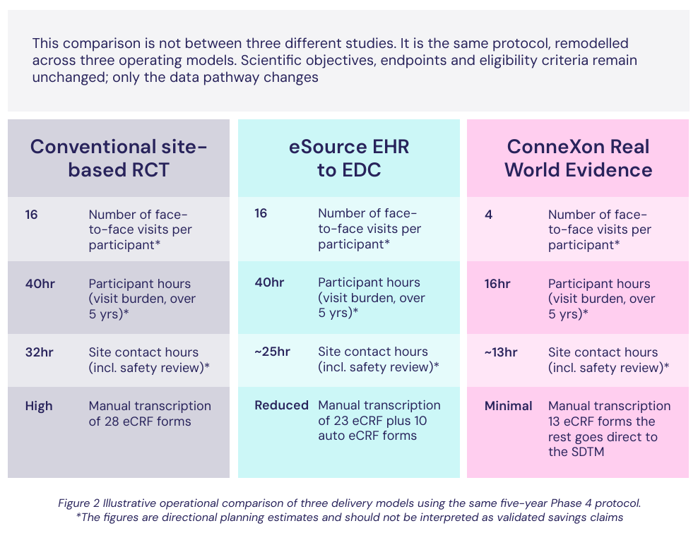
These figures are directional planning estimates rather than validated savings claims. They demonstrate where value may be created and provide measurable hypotheses for sponsor evaluation.
Regulatory and industry developments increasingly support this direction. FDA and EMA guidance recognises the appropriate use of real-world data, decentralised trial elements and proportionate trial conduct, while ICH E6(R3) reinforces risk-based, quality-focused trial design. The key question is no longer whether routine healthcare data can support research, but whether it is reliable, traceable, fit for purpose and governed appropriately.
For pharma leaders, this creates four immediate priorities:
1. Design protocols around data provenance, identifying which data can come from routine care and which require targeted collection, adjudication or clinical assessment.
2. Assess data fitness early, before protocol decisions make duplication unavoidable.
3. Refocus oversight on what matters, including critical-to-quality factors, exceptions, safety signals, missingness and data lineage.
4. Measure transformation by work removed, participant burden reduced and the speed with which reliable evidence becomes usable, not simply by the number of systems connected.
The opportunity is bigger than improving data entry. It is to make clinical research more integrated, proportionate and participant-centred by embedding it within everyday healthcare. This is the next evolution beyond eSource: moving from digitising the traditional trial model to building research around trusted healthcare data.
Read the full Beyond eSource white paper here