




NWEH enables life sciences organisations to generate real-world evidence (RWE) by combining routinely collected healthcare data with focused, study-specific data collection.
Powered by FARSITE and ConneXon, our approach brings together study feasibility, participant recruitment, clinical research delivery, data integration and analysis-ready dataset generation into one connected research model.
This enables sponsors to generate evidence that reflects how treatments are used in everyday healthcare.

FARSITE enables research teams to assess study feasibility using pseudonymised electronic health records, understand eligible patient populations and identify potentially suitable participants through connected primary care data.
GP-reviewed recruitment pathways can help sponsors reach broader populations and support participation closer to home.
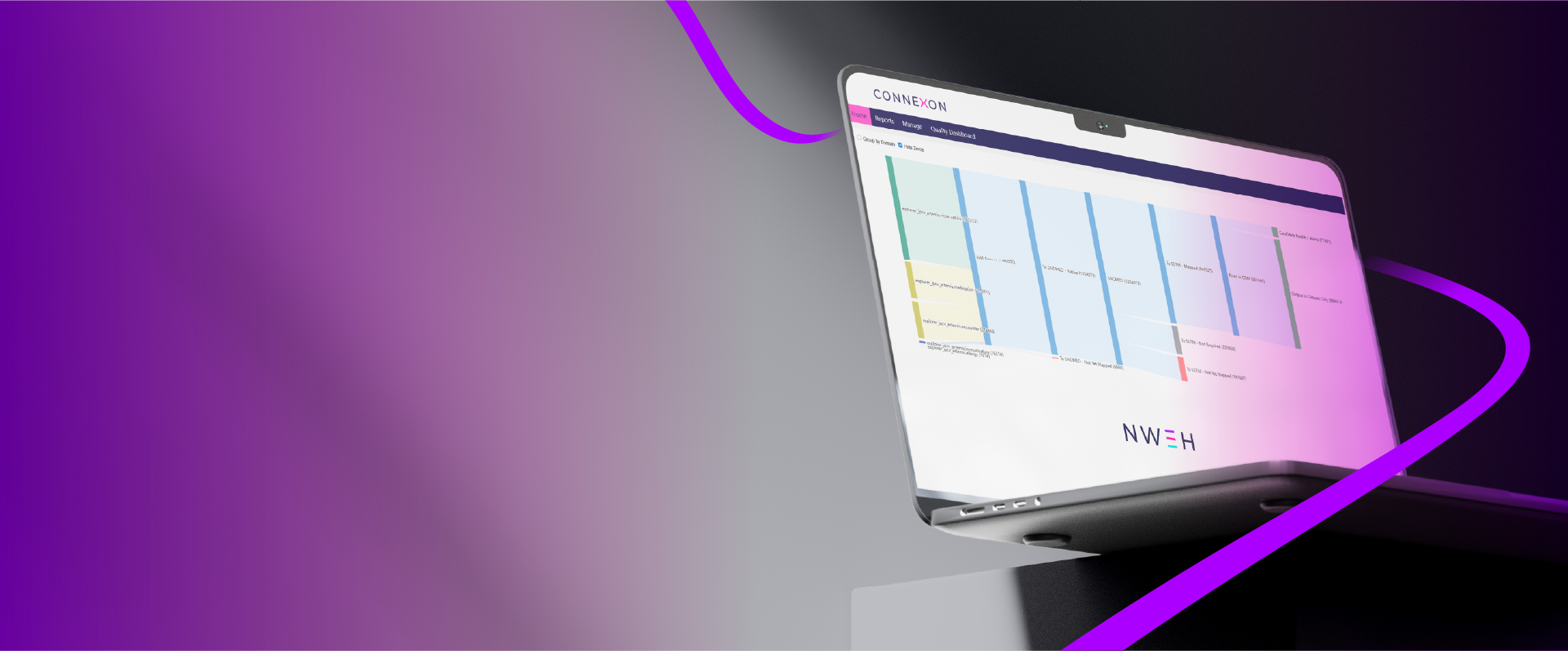
ConneXon brings together routinely collected healthcare information and study-specific data within a governed research environment.
By capturing additional information only where needed, study teams can reduce unnecessary administrative work. NWEH supports pragmatic and decentralised clinical trials, enabling suitable research to take place through local healthcare providers and participants’ everyday care.
Authorised users are able to monitor study activity as it happens, reviewing participant outcomes, safety events and incoming clinical information through a longitudinal event view to support timely data review, more complete follow-up and improved operational oversight.
Primary care electronic health record data is typically processed daily to provide near-real-time visibility without requiring sites to manually re-enter the same information.
ConneXon transforms and standardises data from multiple sources to support clinical and statistical analysis. Its Dataset Generator can produce analysis-ready outputs, including CDISC SDTM and OMOP-aligned datasets where required.
This creates a traceable route from source data to research outputs, supporting effectiveness and safety studies, Medical Affairs, health economics and outcomes research (HEOR), registries and post-authorisation safety studies (PASS).
ConneXon supports registries that bring together longitudinal healthcare data and, where required, questionnaires or other purpose-specific information.
This enables research teams to follow registry members over time to understand disease progression, care pathways and outcomes. Configurable alerts can also flag relevant health events or changes for authorised teams to review, subject to the registry’s permissions and available connected data.

NWEH brings over 10 years of experience using routinely collected healthcare data in clinical research, including the landmark Salford Lung Study, which demonstrated how a pre-licence medicine could be evaluated through a large-scale randomised trial embedded in everyday clinical practice.
By connecting primary and secondary care data, community pharmacies and clinical research processes, the studies helped establish an approach to evaluating treatment effectiveness and safety in real-world populations, with research more closely integrated into routine healthcare.
ConneXon builds on this experience through a configurable platform that connects healthcare data to support contemporary real-world studies, longitudinal follow-up and evidence generation that reflects how patients receive care in everyday life.
NWEH works with sponsors to determine the appropriate population, study design, data sources, additional measures and follow-up requirements.
Real-world data (RWD) is health information generated through routine healthcare and everyday patient experiences. Sources can include electronic health records, hospital data, prescriptions, laboratory results, patient-reported outcomes, wearables and other connected healthcare systems.
Real-world evidence (RWE) is the clinical insight generated by analysing appropriate real-world data to answer a defined research question. Real-world data is the source; real-world evidence is the result.
NWEH connects population discovery, participant recruitment, clinical research delivery, data integration and analysis-ready dataset generation. Powered by FARSITE and ConneXon, our approach combines routinely collected healthcare data with study-specific information where needed, helping sponsors generate evidence grounded in everyday healthcare.
NWEH can support retrospective analyses, prospective observational research, longitudinal cohorts, registries and pragmatic or decentralised interventional clinical trials. The appropriate approach depends on the research question, study objectives and available data sources.
Yes. Real-world data can support prospective, randomised and pragmatic clinical trials. Research using real-world data does not have to be observational or non-interventional. NWEH works with sponsors to determine how routine healthcare data can complement or extend conventional clinical trial data collection.
FARSITE supports population discovery, study feasibility and participant recruitment through connected primary care data. ConneXon integrates routine healthcare and study-specific data, supports clinical study delivery and transforms combined information into analysis-ready outputs.
Together, they connect key stages of the evidence generation process.
Yes. ConneXon can combine data from connected healthcare systems with study-specific information collected through its configurable electronic data capture (EDC) functionality. This allows study teams to capture additional information where needed, rather than duplicating data that is already available reliably from other sources.
ConneXon includes configurable electronic data capture, but it is primarily a data-first clinical research platform. It integrates information from multiple sources, supports study delivery and transforms combined data into analysis-ready datasets.
Depending on the study requirements and available integrations, ConneXon can bring together primary care records, hospital data, prescriptions, laboratory results, patient-reported outcomes, electronic consent, central laboratory data, wearables, study-specific eCRFs and other sponsor or partner systems.
Data sources are selected according to the research question and study requirements.
Data availability depends on the source system and study integration. Primary care electronic health record data is typically processed on a daily cycle, providing near-real-time visibility of relevant participant information. Other sources may have different update schedules.
Not necessarily. The appropriate approach depends on the protocol and research question. Routine healthcare data can reduce unnecessary data collection, while study visits and eCRFs can be retained for assessments that require direct participant interaction or are not reliably captured in routine care.
ConneXon can transform real-world and study-specific data into analysis-ready outputs, including CDISC SDTM and OMOP-aligned datasets where required. The appropriate standards, mappings and outputs are agreed according to each study’s requirements.
ConneXon supports defined data transformations, terminology mapping, audit trails, data lineage and source-to-output traceability. These processes help research teams understand where data originated and how it was transformed. Data quality and suitability must also be assessed in the context of the study and its intended use.
Data processing is governed by the relevant study approvals, consent requirements and access arrangements. ConneXon supports role- and permission-based access, audit trails and privacy-conscious use of participant identifiers. Specific safeguards and governance requirements are determined for each study.
Yes. Real-world evidence can support clinical development, pharmacovigilance and safety monitoring, Medical Affairs, health economics and outcomes research (HEOR), market access and post-authorisation research. Applications may include assessing treatment effectiveness, understanding patient characteristics, investigating longer-term outcomes and evaluating healthcare resource utilisation.
Real-world data and research delivered through local healthcare settings can help sponsors reach broader patient populations and reduce some barriers associated with frequent visits to specialist research centres. However, representative participation also depends on study design, eligibility criteria, recruitment pathways and accessible participant information.
Subject to appropriate consent, governance and study design, longitudinal data can support extended follow-up, refreshed analyses and new research questions as additional information becomes available. This can help sponsors develop an evolving evidence base rather than relying solely on one-off analyses.
NWEH works with sponsors to understand the research question, target population, study design, available data sources, required outcomes, follow-up period and intended outputs. This helps determine which information can be obtained from routine healthcare data and where additional study-specific collection is needed.